j. s. bach
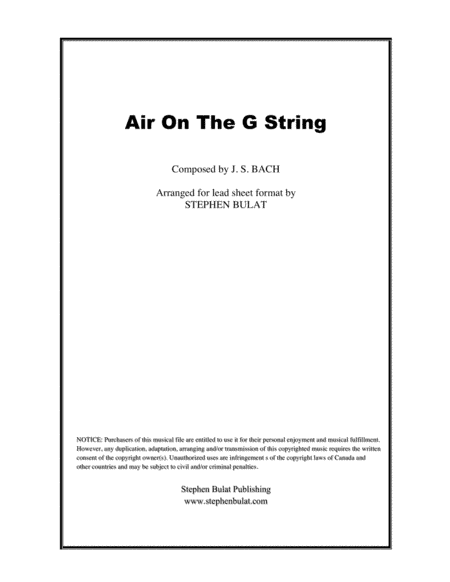
Air on G String (Bach) - lead sheet (key of E) (arr. Stephen Bulat)
Preço
Description
Additional details
- Provider: Sheet Music Direct
- Instrument: Alto Recorder, Alto Saxophone, Banjo, Bassoon, Clarinet, English Horn, Flute, Guitar, Harpsichord, Oboe, Organ, Piano, Recorder, Soprano Recorder, Soprano Saxophone, Tenor Recorder, Tenor Saxophone, Trumpet, Ukulele, Viola, Violin, Voice
- Publisher: Stephen Bulat Publishing
More information
Discover key insights about the composition, arrangement, and composer, see what's included, and find information to enhance your practice and performance.
Johann Sebastian Bach's "Air on the G String," originally the second movement of his Orchestral Suite No. 3 in D major, BWV 1068, stands as one of the most recognizable and beloved melodies in classical music. Its serene and graceful nature has captivated audiences for centuries, transcending its original context to become a cultural icon. This lead sheet arrangement, skillfully adapted by Stephen Bulat and transposed to the key of E, offers a fresh perspective on this enduring masterpiece.
A Journey Through Time:
To truly appreciate this arrangement, consider the journey of the original composition. Bach, a towering figure of the Baroque era, composed the Orchestral Suite No. 3 around the first half of the 18th century, likely sometime between 1717 and 1723, during his tenure as Kapellmeister in Köthen. Orchestral suites of this time were collections of dance-inspired movements, and while Bach infused them with his characteristic complexity and artistry, they were intended to be both pleasing and accessible.
The "Air," however, possessed a quality that set it apart. Its simple, lyrical melody, carried by the strings, created an atmosphere of profound peace and contemplation. August Wilhelmj, a 19th-century German violinist, is largely responsible for popularizing the piece as "Air on the G String." He transposed the key to C major and famously arranged the melody to be played solely on the G string of the violin, showcasing its rich and resonant tone. This arrangement contributed significantly to the piece's widespread fame.
Adaptation and Interpretation:
Stephen Bulat's lead sheet arrangement in the key of E offers new possibilities for interpretation. Lead sheets, focusing on melody and chord changes, provide a framework for musicians to create their own unique performances. Transposing the key allows performers to explore different timbral qualities and adapt the piece to suit various instrumental ranges and ensembles. The key of E adds a brightness and clarity to the melody, offering a subtle but noticeable change in character.
Versatility and Enduring Appeal:
The beauty of "Air on the G String" lies not only in its inherent elegance but also in its adaptability. It has been featured in countless films, television shows, and commercials, often used to evoke feelings of tranquility, reflection, or nostalgia. Its presence in popular culture underscores its timeless appeal and its ability to resonate with diverse audiences. Whether performed as a solo piece, incorporated into a larger ensemble arrangement, or used as inspiration for new compositions, Bach's "Air" continues to inspire and move listeners around the world. This lead sheet arrangement provides a valuable resource for musicians seeking to explore this iconic melody and create their own interpretations.
Sheetmusicstores.com offers this sheet music for you to enjoy!
Related sheet music

Mendelssohn: Wedding March for Baritone Sax & Piano
felix bartholdy mendelssohn

Mendelssohn: Wedding March for Soprano Sax & Piano
felix bartholdy mendelssohn

Ma'oz Tzur — Hanukkah hymn arranged for brass quintet
todd marchand
Arien-Album -- Famous Arias for Baritone/Bass and Piano
various

Ain't Misbehavin'
hank williams jr., thomas "fats" waller, daryl mckenzie
Easy Piano Music of the 18th and 19th Century – Volume I
various

Listen To Scandinavia

Festival Performance Solos - Volume 1 (Clarinet)
johann sebastian bach, richard wagner, moritz moszkowski, fritz kreisler, carl bohm, gustave langenus, hugh stuart

#LIKE Volume ONE & Volume TWO
henry purcell, johann sebastian bach, wolfgang amadeus mozart, franz schubert

Take Five
paul desmond, keith terrett


Air On The G String (Bach) - Lead sheet (key of E) (arr. Stephen Bulat)
j. s. bach, stephen bulat