Unavailable
Tis well with him who on the Lord (Wohl dem, der sich auf seinen Gott) is currently unavailable
We can no longer provide this arrangement through Sheet Music Stores. The listing stays online so you can learn about the piece and explore alternatives.
Try these next steps
- Discover similar sheet music curated for you below.
- Search for “Tis well with him who on the Lord (Wohl dem, der sich auf seinen Gott)” across our catalog.
About this arrangement
Orchestra Soli SATB, Coro SATB, 2 Obda, 2 Vl, Va, [Vcpic], Bc SKU: CA.3113907 Cantata for the 23rd Sunday after Trinity. Composed by Johann Sebastian Bach. Edited by Klaus Hofmann. Arranged by Sven Hiemke. Stuttgart Urtext Edition: Bach vocal. Sacred vocal music, Cantatas, End of the church year, Trinity, Praise and thanks. Study score. Composed 1724. BWV 139. 40 pages. Duration 20 minutes. Carus Verlag #CV 31.139/07. Published by Carus Verlag (CA.3113907). ISBN 9790007244965. Language: German/English. Text: Rube, Johann Chr.Bach's chorale cantata with its opening text "Wohl dem, der sich auf seinen Gott recht kindlich kann verlassen" (Tis well with him who on the Lord trusts just like a child) BWV 139 was performed for the first time on 12 November 1724 in the main Leipzig church service. The cantata text, based on the hymn of the same name by Johann Christoph Rube (1665-1746), is in praise of trust in God. In the opening chorus, full of depth of feeling, the hymn melody is heard throughout; this is followed by a lively tenor aria "Gott ist mein Freund" (God is my friend) with a musical depiction of the adversary raging in vain, and in the bass aria "Das Ungluck schlagt auf allen Seiten" (Misfortune assails me on every side) Bach presents both drama and Baroque imagery. One of the two solo violin parts for the tenor aria is lost, so our edition offers a reconstruction. The virtuoso violin part of the bass aria was evidently based on a part for violoncello piccolo, now lost. The edition provides for performance by violin or violoncello. Score available separately - see item CA.3113900.
Related sheet music

Frohlocket, ihr Volker, und jauchzet, ihr Heiden
johann kuhnau
Frohlocket, ihr Volker, und jauchzet, ihr Heiden
johann kuhnau


Frohlocket, ihr Volker, und jauchzet, ihr Heiden
johann kuhnau

Frohlocket, ihr Volker, und jauchzet, ihr Heiden
johann kuhnau
Frohlocket, ihr Volker, und jauchzet, ihr Heiden
johann kuhnau
Frohlocket, ihr Volker, und jauchzet, ihr Heiden
johann kuhnau
Rediscovered Treasures For Violin/Cello/Piano Sc/Pts
various


Frohlocket, ihr Volker, und jauchzet, ihr Heiden
johann kuhnau

Frohlocket, ihr Volker, und jauchzet, ihr Heiden
johann kuhnau
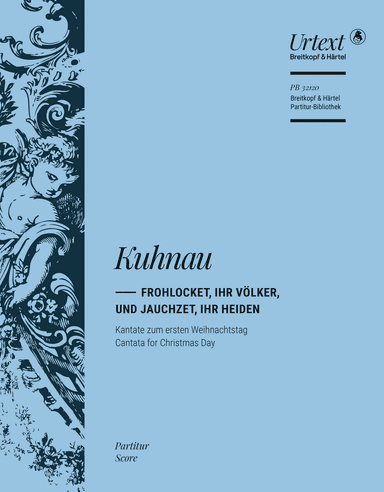
Frohlocket, ihr Volker, und jauchzet, ihr Heiden
johann kuhnau
New · Grammar of Music
Understand the music behind every score
Grammar of Music is our new interactive music theory system. Every interval, chord and progression plays as you read, so you train your ear while you learn — and every score you pick up starts to make sense.
- Hear every concept, not just read it
- Chord dictionary, circle of fifths and more
- Guided courses from basics to harmony
No account needed to get started.